Oil&Gas-Corrology
Brief Summary of the Model
Corrosion due to the combined presence of carbon dioxide (CO₂) and hydrogen sulfide (H₂S) is a well-known challenge in oil and gas production and transmission systems. These acidic gases create an aggressive environment that can lead to severe degradation of commonly used carbon steel infrastructure. The corrosion resulting from these gases and associated contaminants poses a significant threat to the integrity of production and transmission equipment.
As a result, operators employ various approaches to quantify system corrosivity in order to support informed decisions for project development and operational planning. A semi-mechanistic corrosion prediction model has been developed for multiphase CO₂/H₂S environments in oil and gas production and transportation systems to support this assessment. The model integrates water chemistry, multiphase flow, and corrosion modules to enable engineers to quickly assess corrosion risk and system aggressiveness.
The model foundation is based on the “resistance model” 1 , as shown in Equation 1:
1/Vcor = 1/Vr + 1/Vm (Equation 1)
The base corrosion rate component Vr is adapted from the well-established de Waard equation (1993)2 , with modifications to incorporate the effect of H₂S. An equivalent CO₂ partial pressure (CO₂eqv), adjusted for system pH, is used in place of the actual CO₂ partial pressure in the Vr equation, as shown below:
log Vr = 5.8 – 1710/T + 0.67 log (CO2eqv) (Equation 2)
The Vm term accounts for limiting factors due to various species.
The model also incorporates correction factors for additional influences, including FeCO3 / FeS scale formation, saturation pH, H₂S concentration, chloride content, gas fugacity, flow behavior, water cut & oil wetting, and inhibition. A high-level flowchart of the model is presented in Figure 1.

Model Validation
pH Model Evaluation
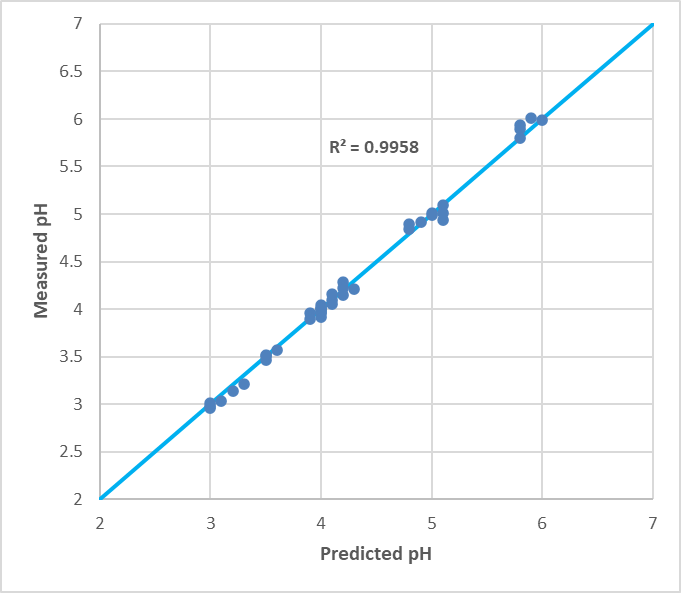
The pH prediction component of the model was validated using measured data reported by A.Miyasaka.26 The validation dataset includes pH measured at two temperature levels -298 K (25 °C) and 333 K (60 °C) – under a range of CO₂ and H₂S gas compositions and bicarbonate (HCO₃⁻) concentrations.
As shown in Figure 2, the predicted pH values demonstrate excellent agreement with the measured values, with a coefficient of determination (R²) of 0.9958. This good correlation confirms the model’s capability to accurately estimate in-situ pH, thereby enhancing its reliability for corrosion rate predictions.
Corrosion Model Evaluation
The corrosion prediction model was validated using a combination of field and laboratory data representative of upstream oil and gas conditions. These validation cases were drawn from multiple published studies, covering a wide range of operational environments including variations in temperature, pressure, gas composition, water chemistry, and flow.4 ,5 ,6 Corrosion rates measured from wells and production systems across different fields were compared with model predictions. Table 1 summarizes a selection of these field datasets used for evaluation.
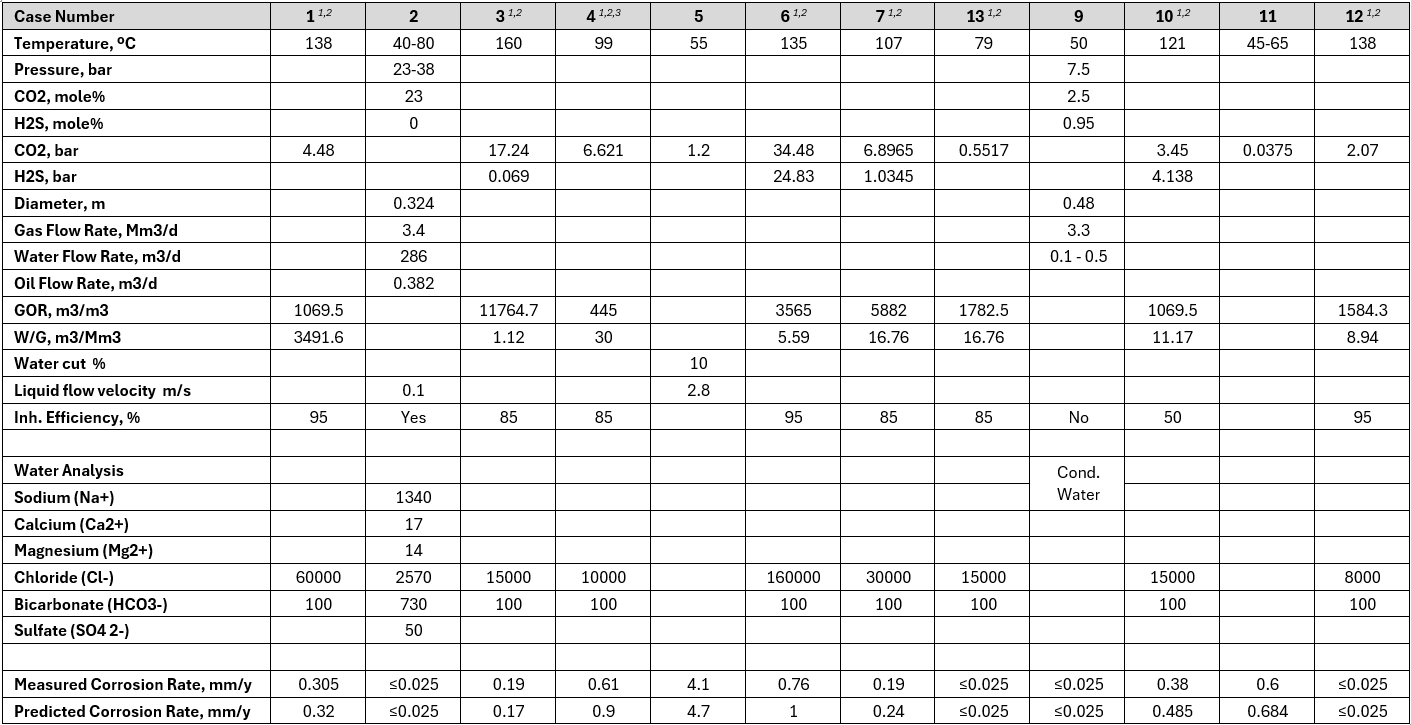
Table 1 Summary of selected field data used for corrosion model validation.
Oil&Gas-Corrology®
This tool enables accurate assessment of CO₂/H₂S corrosion by incorporating key parameters such as temperature, pressure, CO₂ and H₂S partial pressures, flow, and the presence of ionic species—including weak organic acids like acetic and formic acid. The model outputs include corrosion rate, in-situ pH, ionic strength, balancing ion concentrations, and saturation pH, which can help in assessing the scaling potential.
References
This Article has 6 references.
1: V.R. Jangama, S. Srinivasan - A Computer Model For Prediction Of Corrosion Of Carbon Steels - NACE Corrosion 1997, paper no. 97318
2: C. de Waard, U. Lotz - Prediction Of CO₂ Corrosion Of Carbon Steel - NACE Corrosion 1993, paper no. 69
3: A. Miyasaka - Thermodynamic Estimation of pH of Sour and Sweet Environments as Influenced by the Effects of Anions and Cations - NACE Corrosion 1992, paper no. C1992-92005
4: L. Lazzari, A. Kopliku, G. Hoxha, M. Cabrini, P. Pietro - Prediction of CO2 Corrosion in Oil and Gas Wells: Analysis of Some Case Histories - NACE Corrosion 1998, paper no. 98024
5: R. Nyborg - Field Data Collection, Evaluation and Use for Corrosivity Prediction and Validation of Models – Part II: Evaluation of Field Data and Comparison of Prediction Models - NACE Corrosion 2006, paper no. 06118
6: KM Yap, S. Srinivasan, V.V. Lagad - Field Data Collection, Evaluation and Use for Corrosivity Prediction and Validation of Models – Part II: Evaluation of Field Data and Comparison of Prediction Models - NACE Corrosion 2012, paper no. C2012-0001216
- 1 - A constant amount of 100 ppm of bicarbonate was added, as specified in the source paper
- 2 - A constant fluid velocity of 20 ft/s (6.1 m/s) was used, as specified in the source paper
- 3 - With no oil protection, as specified in the source paper