CO₂ / H₂S Corrosion
General Information
CO2 corrosion in oil and gas production and transmission systems has been extensively studied over the last decades. The effects of various key parameters, such as temperature, pH, CO2 partial pressure and the presence of H2S etc., have also been examined and, in many cases, these findings are used to assess and predict system corrosivity. The following chapter provides a general overview of CO2/H2S corrosion, the impact of these parameters and corrosion modelling approach.
Mechanism
Anhydrous CO2 (dry gas) is considered non-corrosive. However, in the presence of water, it dissolves and forms weak carbonic acid, which leads to a reduction in pH and subsequent corrosion of carbon steel. The fundamental mechanism of CO2 corrosion is relatively well understood and has been described by many researchers, including the seminal work of De Waard and Milliams, Crolet, Dugstad and others. 1 2 3 4
Simplified anodic and cathodic reactions describing principles of CO2 corrosion is presented below:
\(\ce{Fe -> Fe^2+ + 2e-}\) Reaction 1
\(\ce{H2CO3 + e- -> HCO3- + 2H+}\) Reaction 2
\(\ce{H+ + H+ -> H2}\) Reaction 3
Which can be presented in summary reaction:
\(\ce{Fe + 2H2CO3 -> Fe^2+ + 2HCO3- + H2}\) Reaction 4
During the progression of CO2 corrosion, the bicarbonate ion concentration in the solution increases, which in turn raises the pH level. Once this concentration exceeds the saturation equilibrium, iron carbonate precipitates, as illustrated schematically in Reaction 5.
\(\ce{Fe + 2HCO3- -> FeCO3 + H2O + CO2}\) Reaction 5
Depending on the impact of various process parameters such as temperature, flow rate, and the CO2/H₂S ratio, the FeCO₃ layer will exhibit varying properties, including density and porosity. However, regardless of these variations, the presence of an FeCO₃ deposit on the metal surface consistently leads to a reduction in the corrosion rate, which may be more or less significant depending on the specific conditions.
Key Variables
It is widely agreed that CO2 corrosion is influenced by a combination of several parameters, including temperature, pH, CO2 concentration, the presence of H2S, flow, and other ionic species, particularly chlorides. Additional factors that may also affect the final CO2 corrosion rate include the presence of oxygen, elemental sulfur, and the oil wetting effect, among others.5 6
CO2 Partial Pressure and Temperature
CO2 partial pressure and temperature are the two critical, influential factors governing CO2 corrosion in oil and gas production and transmission systems. In general, higher CO2 partial pressure increases carbonic acid formation, lowers pH, and accelerates the corrosion rate. Temperature, on the other hand, influences corrosion in multiple ways: corrosion increases with temperature due to faster corrosion process; at higher temperature, conditions increasingly favor the formation of protective iron carbonate (FeCO3) films; affecting solubility and equilibrium constants, thereby impacting the pH. There is a general consensus that in an ideal, pure CO2 system, the corrosion rate increases with temperature, reaching its peak within the range of 60–80°C (140–176°F). Beyond this point, the corrosion rate begins to decrease, and at temperatures above approximately 120°C (248°F), it becomes almost independent of CO2 partial pressure.2 The reduction in corrosion is primarily attributed to the formation of protective corrosion products, such as FeCO3 (iron carbonate). These behaviors are commonly modeled using the well-known De-Waard-Milliams equation:
log (Vcor) = 5.8 - 1710/T + 0.67 log (pCO2) (Equation 1)
pH
The pH is closely related to the previously discussed parameters, such as CO2 partial pressure and temperature. Generally, an increase in pH is associated with a decrease in the corrosion rate. This is primarily due to the slowing of the cathodic reduction of H+ ions, which, according to Le Chatelier’s Principle, causes the anodic reaction to counteract, thereby slowing the dissolution of the metal. Additionally, as the pH increases, the solubility of FeCO3 decreases, leading to the precipitation of iron carbonate. This precipitated layer acts as a protective barrier on the metal surface, further reducing the corrosion rate. This dual effect - slowing the cathodic reaction and promoting protective film formation -underscores the importance of pH in controlling corrosion processes in CO2-containing environments.4 Therefore, accurate determination of pH is a critical component in all CO2 corrosion models. It is widely agreed that utilizing ionic modeling, based on known ionic speciation, is the preferred method for estimating field pH. This approach offers several advantages over direct water sampling and pH measurement under high operating pressures, which can be complex, costly, and prone to errors due to the challenges of maintaining gas-liquid equilibrium during sampling and measurement. By using ionic modeling, it is possible to achieve more reliable and consistent pH estimates that better reflect the in-situ conditions of the system, thereby enhancing the accuracy of corrosion predictions.
H2S
H2S is also widely encountered in most oil and gas production systems. Even in small amounts, H2S may significantly influence corrosion behavior. As the H2S concentration (or partial pressure) increases in the process stream, the corrosion dynamics shift, largely depending on the CO2/H2S ratio. When H2S concentrations are negligible (less than 68 Pa or 0.01 psia), CO2-driven corrosion remains the primary mechanism, with a reduction in the corrosion rate observed above 60-80°C, as previously discussed. However, as the CO2 partial pressure to H2S partial pressure ratio (CO2pp/H2Spp) exceeds 200, H2S begins to react with iron to form iron sulfides (FexSy), which can decrease the overall corrosion rate. The scale formed under these conditions is typically a mixture of (FexSy) and FeCO3, which acts as a protective barrier against further corrosion.7 At higher H2S concentrations, where the CO2pp/H2Spp ratio falls below 200, the dominant scale compound between approximately 60°C and 240°C becomes FexSy. This iron sulfide scale is generally protective; however, once the temperature surpasses the 230-240°C range, the corrosion rate may increase again due to the scale becoming porous, which compromises its protective properties and allows H2S corrosion to progress.7
Oxygen
Ingress of oxygen, typically resulting from inadequately de-aerated injection water or brine, can significantly accelerate corrosion in sweet environments, where carbon dioxide (CO2) is the primary corrosive agent. Several studies have shown that the rate of CO2-induced corrosion can increase by approximately 0.5 mm/year for every 1 ppm of oxygen contamination.8 However, it is crucial to recognize that under actual field conditions, this rate may vary due to the complex interaction of multiple factors, including flow velocity, temperature, pressure, and the specific chemistry of the water or brine being injected.
The presence of oxygen is believed to degrade the protective FeCO₃ (iron carbonate) layer that typically forms on metal surfaces, making it porous and more susceptible to penetration by corrosive species. Consequently, the corrosion process is exacerbated. In oxygenated conditions, the composition of surface deposits on the metal will include not only FeCO₃ but also iron oxide phases such as magnetite (Fe₃O₄), hematite (α-Fe₂O₃), and goethite (α-FeOOH).9
Flow, Oil Type and GOR
In oil and gas production and transmission systems, oil, water, and gas typically exist as a mixture. These phases flow together in complex patterns within pipelines, which can impact pipeline integrity. Therefore, characterizing multiphase flow is crucial for understanding how hydrodynamic factors affect corrosivity and integrity of a system. A multiphase flow modeling tool is available in the Tool section for further analysis.
There is a general agreement that in oil wells with a Gas/Oil Ratio (GOR) below 890 m³/m³ or 5000 scf/bbl, crude oil forms a stable hydrophobic layer on metal surfaces. This layer prevents water from contacting the metal, thereby reducing both sweet and sour corrosion rates. 7 10 11 12 13
However, the relationship between “oil wetting” and corrosion is more complex, involving the interplay of factors such as oil type (including API gravity), water cut, water-in-oil emulsion stability, and the flow regime within the well. Oil’s protective tendency is typically most evident when the water cut (WC) is around 30-40% and linear flow velocities exceed approximately 1 m/s.2 7 The specified water-cut boundary is not fixed and may vary depending on the specific properties of the crude oil. For instance, heavier crude oils, particularly those rich in asphaltenes and resins (with an API gravity of approximately 20 or lower) and capable of forming stable emulsions, may offer sufficient protection even at water cuts exceeding 50%.11 14 15 16
Inhibitors
The application of corrosion inhibitors is a widely used and effective method for controlling corrosion in oil and gas (O&G) production systems, both in sweet (CO2) and sour (H₂S) environments. Over the last few decades, a significant number of compounds have been developed, tested, and successfully implemented as corrosion inhibitors in the O&G industry. The majority of these compounds are film-forming inhibitors, which create protective mono- or multi-layer films on the metal surface. These films act as a barrier, significantly retarding the ingress of water and other corrosive species, and thus reducing the rate of electrochemical reactions that lead to both sweet and sour corrosion.
Among the most popular and widely used corrosion inhibitors in the industry are fatty imidazoline derivatives, amide-imidazolines, or quaternary amine salts. These compounds are often used either individually or in mixtures to optimize their performance and provide comprehensive protection against corrosion. Fatty acids imidazoline derivatives are particularly valued for their strong film-forming properties and stability, while quaternary amine salts are known for their effectiveness in inhibiting corrosion in acidic environments. The combination of different inhibitors often results in synergistic effects, providing enhanced corrosion protection in complex and harsh conditions commonly encountered in O&G production systems. 17 18 19 20
Due to the wide variety of commercial inhibitors available, each with different compositions and varying concentrations of active components, it is challenging to develop a generalized guideline that correlates dosage, inhibitor type, and the resulting corrosion rate reduction. However, it is possible to provide some general estimations for one of the most widely used groups of inhibitors—fatty acid imidazolines. These inhibitors have been extensively evaluated over the past several decades under a range of conditions, including varying levels of CO2 partial pressure, flow, and other environmental factors.
Typically, a continuous dosage of 3-10 ppm of fatty acid imidazolines (measured as the active component) is expected to reduce the rate of sweet corrosion by approximately 80% to over 90%.21 22 23 24 Of course, the final inhibition effectiveness will also be influenced by several other factors, including water cut, oil type (light vs. heavy), flow conditions (such as wall shear stress and flow type), and the partitioning behavior of the inhibitor between the water and oil phases.25
O&G-Corrology
A semi-mechanistic corrosion prediction model has been developed for multiphase CO2/H2S environments in oil and gas production and transportation systems to support corrosion assessment. The model integrates water chemistry, multiphase flow, and corrosion modules to enable engineers to quickly assess corrosion risk and system aggressiveness.
The model foundation is based on the “resistance model” 27 , as shown in Equation 2:
1/Vcor = 1/Vr + 1/Vm (Equation 2)
The base corrosion rate component Vr is adapted from the well-established de Waard equation (1993)2 , with modifications to incorporate the effect of H₂S. An equivalent CO2 partial pressure (CO2eqv), adjusted based on system pH, is used in place of the actual CO2 partial pressure in the Vr equation, as shown below:
log Vr = 5.8 – 1710/T + 0.67 log (CO2eqv) (Equation 3)
The Vm term accounts for limiting factors due to various species.
The model also incorporates correction factors for additional influences, including FeCO3 / FeS scale formation, saturation pH, H2S concentration, chloride content, gas fugacity, flow behavior, water cut & oil wetting, and inhibition. A high-level flowchart of the model is presented in Figure 1.

Model Validation
pH Model Evaluation
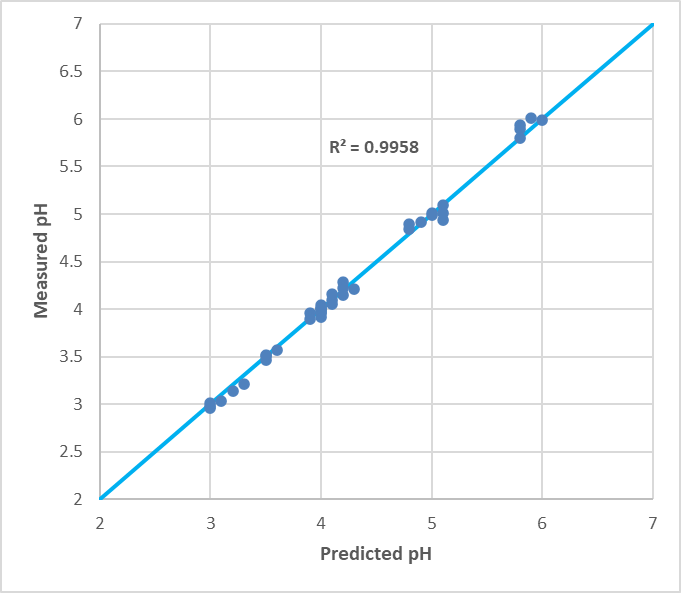
The pH prediction component of the model was validated using measured data reported by A.Miyasaka.26 The validation dataset includes pH measured at two temperature levels -298 K (25 °C) and 333 K (60 °C) – under a range of CO₂ and H₂S gas compositions and bicarbonate (HCO₃⁻) concentrations. As shown in Figure 2, the predicted pH values demonstrate excellent agreement with the measured values, with a coefficient of determination (R²) of 0.9958. This good correlation confirms the model’s capability to accurately estimate in-situ pH, thereby enhancing its reliability for corrosion rate predictions.
Corrosion Model Evaluation
The corrosion prediction model was validated using a combination of field and laboratory data representative of upstream oil and gas conditions. These validation cases were drawn from multiple published studies, covering a wide range of operational environments including variations in temperature, pressure, gas composition, water chemistry, and flow.27 ,28 ,29 ,30 Corrosion rates measured from wells and production systems across different fields were compared with model predictions. Table 1 summarizes a selection of these field datasets used for evaluation.
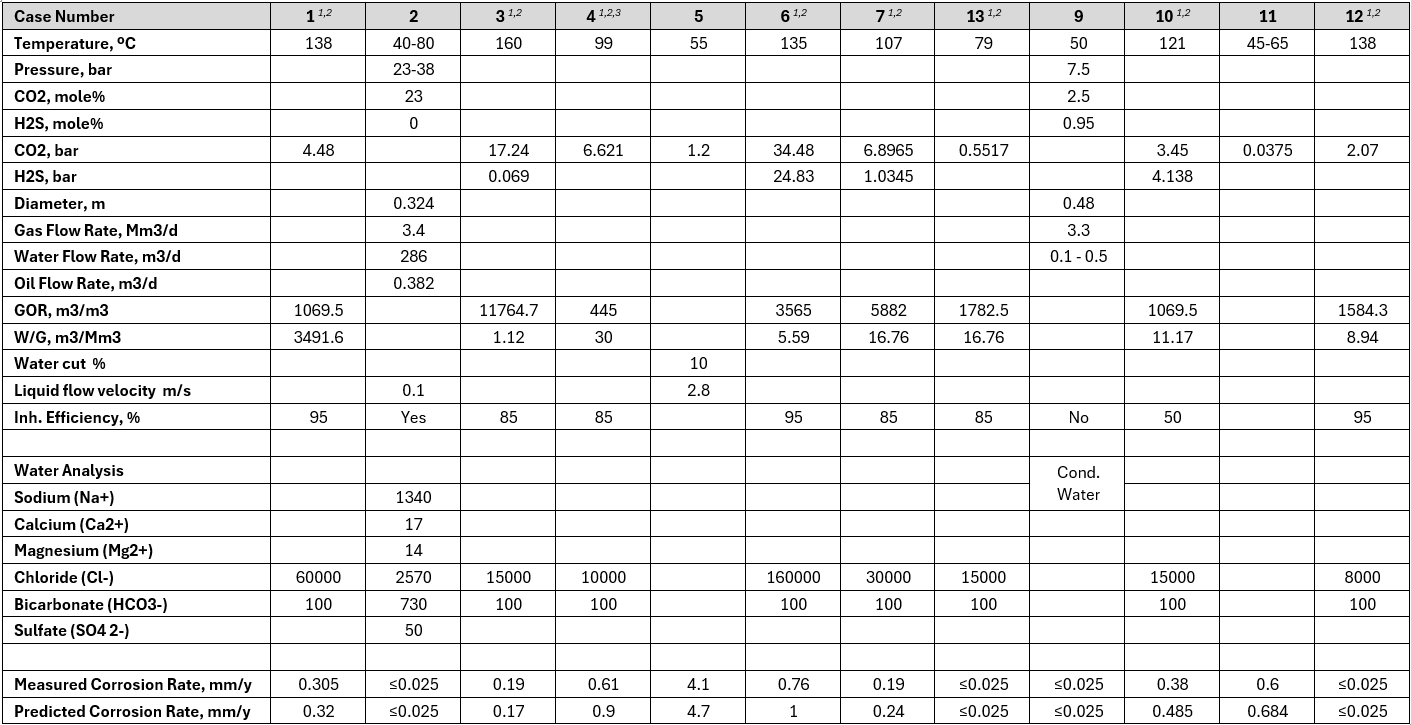
Table 1 Summary of selected field data used for corrosion model validation.
References
This Article has 30 references.
1: C. de Waard, D.E. Milliams - Carbonic Acid Corrosion Of Steel - Corrosion 31, 5, 1975, 177
2: C. de Waard, U. Lotz - Prediction Of CO₂ Corrosion Of Carbon Steel - NACE Corrosion 1993, paper no. 69
3: M.R. Bonis, J.L. Crolet - Basics Of The Prediction Of The Risks Of CO₂ Corrosion In Oil And Gas Wells - NACE Corrosion 1989, paper no. 466
4: A. Dugstad - Fundamental Aspects of CO₂ Metal Loss Corrosion Part I: Mechanism - NACE Corrosion 2006, paper no. 06111
5: G. Schmitt, M. Hörstemeier - Fundamental Aspects Of CO₂ Metal Loss Corrosion – Part II: Influence Of Different Parameters On CO2 Corrosion Mechanisms - NACE Corrosion 2006, paper no. 06112
6: KM. Yap, S. Srinivasan - Key Factors In Development Of A CO₂/H2S Corrosion Prediction Model For Multiphase Oil / Gas Production Systems - NACE Corrosion 2010, paper no 10374
7: S. Srinivasan, R.D. Kane - Prediction Of Corrosivity Of CO₂/H2S Production Environments - NACE Corrosion 1996, paper no. 11
8: R.L. Martin - Corrosion Consequences of Oxygen Entry Into Oilfield Brines - NACE Corrosion 2006, paper no. 02270
9: N.R. Rosli, Y-S. Choi, D. Young - Impact of Oxygen Ingress in CO₂ Corrosion of Mild Steel - NACE Corrosion 2014, paper no. 4299
10: S. Olsen, A.M. Halvorsen, P.G. Lunde, R. Nyborg - CO2 Corrosion Prediction Model – Basic Principles - NACE Corrosion 2005, paper no. 05551
11: C. de Waard, L.M. Smith, B.D. Craig - The Influence Of Crude Oils On Well Tubing Corrosion Rates - NACE Corrosion 2003, paper no. 03629
12: B.F.M. Pots, R.C. John, I.J. Rippon, M.J.J. Simon Thomas, S.D. Kapusta, M.M. Girgis, T. Whitham - Improvements On De Waard-Milliams Corrosion Prediction And Applications To Corrosion Management - NACE Corrosion 2002, paper no. 02235
13: S. Richter, M. Babic, X. Tang, W. Robbins, S. Nesic - Categorization of Crude Oils Based on Their Ability to Inhibit Corrosion and Alter the Steel Wettability - NACE Corrosion 2014, paper no. 4247
14: M. Castillo, H. Rincon, S. Duplat, J. Vera, E. Baron - Protective Properties Of Crude Oils In CO₂ And H2S Corrosion - NACE Corrosion 2000, paper no. 00005
15: C. Mendez, S. Duplat, S. Hernfindez, J. Vera - On The Mechanism Of Corrosion Inhibition By Crude Oils - NACE Corrosion 2001, paper no. 01030
16: A.N. Moosavi, G. John - Use Of Corrosion & Flow Modeling For Corrosion Assessment Of An Oil & Gas Field - NACE Corrosion 2002, paper no. 02253
17: M. Achour, J. Kolts - Corrosion Control by Inhibition Part I: Corrosion control by film forming inhibitors - NACE Corrosion 2015, paper no. 5475
18: A. Jayaraman, R.C. Saxena - Corrosion Inhibitors in Hydrocarbon Systems - NACE Corrosion 1996, paper no. 221
19: K. Tsul, J.E. Wong, N. Park - Effect of Corrosion Inhibitor Active Components on Corrosion Inhibition In A Sweet Environment - NACE Corrosion 2010, paper no. 10326
20: A. Crossland, R. Woollam, J. Vera, J. Palmer, G. John, S. Turgoose - Corrosion Inhibitor Efficiency Limits And Key Factors - NACE Corrosion 2011, paper no. 11062
21: A. Prethaler, T. Vogl, G. Mori, W. Havlik, G. Zehethofer, S. Hönig, E. Rosenberg - Evaluation Of Performance Of Gas And Gas Condensate Inhibitors With A Laboratory Two Phase Flow - NACE Corrosion 2014, paper no. 4045
22: M. Reid, Prof. A. Neville, A. Kirkpatrick, C. Campbell - Determining Optimal Dose Rate of Oilfield Corrosion Inhibitors by Step-wise Incremental Dosing - NACE Corrosion 2014, paper no. 4264
23: J.M. Domínguez Olivo, B. Brown, S. Nesic - Modeling of Corrosion Mechanisms in the Presence of Quaternary Ammonium Chloride and Imidazoline Corrosion Inhibitors - NACE Corrosion 2016, paper no. 7406
24: B. Wang, L. Zhang, G. Chen, Q. Li, W. Chang, H. Yao, Y. Liu, Y. Zhang - Corrosion Inhibitor Film Stability under High Gas Velocity Conditions of Subsea Wet Gas Pipeline - NACE Corrosion 2017, paper no. 9247
25: F. Farelas, M. Singer, D. Nugraha, S. Whitehurst, B. Kinsella - Localized Corrosion in the Presence of Corrosion Inhibitors at High Flow Velocities in CO2 Environments - NACE Corrosion 2018, paper no. 11269
26: A. Miyasaka - Thermodynamic Estimation of pH of Sour and Sweet Environments as Influenced by the Effects of Anions and Cations - NACE Corrosion 1992, paper no. C1992-92005
27: V.R. Jangama, S. Srinivasan - A Computer Model For Prediction Of Corrosion Of Carbon Steels - NACE Corrosion 1997, paper no. 97318
28: Y.M. Gunaltun - Combining Research And Field Data For Corrosion Rate Prediction - NACE Corrosion 1996, paper no. 96027
29: R. Nyborg - Field Data Collection, Evaluation and Use for Corrosivity Prediction and Validation of Models – Part II: Evaluation of Field Data and Comparison of Prediction Models - NACE Corrosion 2006, paper no. 06118
30: L. Lazzari, A. Kopliku, G. Hoxha, M. Cabrini, P. Pietro - Prediction of CO2 Corrosion in Oil and Gas Wells: Analysis of Some Case Histories - NACE Corrosion 1998, paper no. 98024
- 1 - A constant amount of 100 ppm of bicarbonate was added, as specified in the source paper
- 2 - A constant fluid velocity of 20 ft/s (6.1 m/s) was used, as specified in the source paper
- 3 - With no oil protection, as specified in the source paper